Advanced Features: From Search to Research
← Previous · Guide home · Topic index · Download PDF · Next →
Finding a historical sale is only the beginning. BSPi also lets members turn scattered auction records into organized, reusable collecting research. Whether you have a single inherited patch, a specialized collection, or a guide you want to share, the advanced tools help you preserve evidence, compare meaningful examples, and present your findings.
Your work has lasting value
The person is the author; the platform is the instrument. BSPi provides historical records, organization, research tools and a place to develop your work. You supply the identification, judgment, context, writing and care that turn those tools into useful knowledge.
Our aim is that your effort should benefit you, strengthen BSPi's shared research resource, and help the collecting community—a win for all three. You should be able to keep the fruits of your labor, develop them into finished guides, share them with others, and benefit economically from your own original work. Research that is not ready for publication should still be worthwhile.
Ownership, portability and independent use are principles we intend to protect. The platform's existing Price Guide proof can be printed or saved as a PDF. A complete, structured export of all original research, annotations and guide relationships, and a formal author agreement covering independent reuse and commercial rights, are not yet documented as available product features. They are requirements for further development, not promises that those controls already exist.
A guide's visibility and permission to publish it are different questions. BSPi may need to retain contributed information for internal searching, classification and organization, but that must not become a back door to republish or sell an author's identifiable work without permission. The precise terms are being developed and will be presented clearly before an author is asked to accept them.
What you can accomplish
| Your goal | BSPi feature | What it helps you do |
|---|---|---|
| Organize related collectibles | Price Guides | Build a browsable guide from individual Saved Items, choose its sequence and visibility. |
| Keep research together | Saved Items | Give an issue or collectible a name and description, then associate historical sales. |
| Review the underlying evidence | Sales Data | Examine, select, and manage the auction records associated with a Saved Item. |
| Look for patterns | Market Analysis | Compare price trends, sale activity, sold status, bid distributions, and price distributions. |
| Document visual details | Image Annotation | Add context to collectible photographs and support identification. |
| Share or print a coherent reference | Price Guide Proof | Review a guide's order, summaries and underlying sales; print or save a PDF. |
See the research workflow
A Price Guide is not simply a list of auction results. The basic structure is historical sale → Saved Item → Price Guide → proof. Each step adds organization and context while retaining access to the evidence.
The image below shows the Price Guide Manager, where members begin assembling guides. The next chapters show how to create items, associate sales, and examine the results.
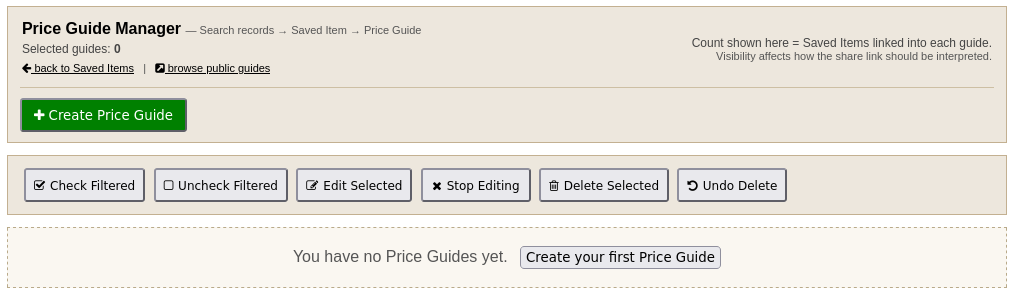
The Price Guide Manager is the starting point for organizing related Saved Items into a larger collecting reference. The creation control is visible here; a guide gains substance as you add and review its items.
Continue below to choose the advanced workflow that matches your goal ↓
Choose where to begin
For an inherited collection, start with Saved Items and build up from individual pieces. For an established collecting specialty, begin with Price Guides and plan the categories you want to cover. If you already have historical sales associated with an item, Sales Data and Market Analysis are the next steps.
Historical prices are evidence, not automatic appraisals. Good comparisons still require attention to issue, condition, completeness, and whether a listing actually sold. The advanced features make that work more manageable; they do not replace the collector's judgment.
You can use these tools for personal research without publishing anything. Sharing or publishing a guide is a separate decision.